More Than 20 Years of tranzit.org. Launch of the book tranzit 20+

4th of July, tranzit ro/ Iasi, in the frame of Iasi Pride 2026 events
Time: 13:00 - 15:00
Str. Sf. Atanasie nr. 25, 700115, Iași
22nd of July, Feredeului Building, in the frame of Imagined Organisations events.
Strada Feredeului 4, MD-2005, Chișinău
18:30-19:30
To mark the occasion of more than twenty years of the tranzit.org network, the book launch for tranzit 20+ will be held in both Iasi (RO) on the 4th of July and Chișinău (MD) on the 22nd of July. The book summarizes the work of the tranzit.org network, which includes tranzit.at (Austria), tranzit.cz (Czech Republic), tranzit.hu (Hungary), tranzit.ro in Iași, Bucharest, and Cluj (Romania), and tranzit.sk (Slovakia). It looks at the network’s history, its current work, and its future plans. The publication shows the experiments, partnerships, methods, and shared support that have kept independent art alive through different political times over the last twenty years.
Contributing authors and artists: Larissa Agel, Karin Akai, Judit Angel, Zbyněk Baladrán, Anca Benera & Arnold Estefán, Florin Bobu, Aleksei Borisionok, Anetta Mona Chişa, Eduard Constantin, Nolan Oswald Dennis, Max Dvořák, ex-artists collective (Tamás Kaszás & Anikó Loránt), František Fekete, Maja Fowkes & Reuben Fowkes, Flóra Gadó, Ines Gebetsroither, Michaela Geboltsberger, Dóra Hegyi, Hollow (Gyula Muskovics, Tamás Páll, Viktor Szeri), Oto Hudec, József Mélyi, Jana Kapelová, Július Koller, Iva Kovač, Isabella Kresse, Júlia Laki, Renan Laru-an, Zsuzsa László, Paula Malinowska, Ina Mertens, Helena Mustakallio, OMARA (Mara Oláh), Livia Pancu, Mirjam Paninski, Lia Perjovschi, Nataša Petrešin-Bachelez, Nela Pietrová, Marlies Pillhofer, Raluca Popa, Emília Rigová, Ivana Rumanová, Georg Schöllhammer, Olga Shparaga, Renata Šikoronja, Save As Team, Borbála Soós, Tereza Stejskalová, The School of Dissolving – Expanding – Reconnecting Imagination (Tereza Čajková, Barbora Kleinhamplová, Eva Koťátková), Ovidiu Țichindeleanu, Attila Tordai-S., Raluca Voinea, Aleksandrina Yordanova.
read more /
The Civic Café: Visibility as a premise of equality!!!

4th of July,
@tranzitiasi, in the frame of Iasi Pride 2026 events
Time: 13:00 - 15:00
Str. Sf. Atanasie nr. 25, 700115, Iași
Program:
13:00 - 13:30 Book launch and performative reading / Launch of the book
tranzit 20+
13:30 - 15:00 Public presentation by Florin Buhuceanu:
Queer visual histories. Visibility as a premise of equality
We are proud to invite you for a joint event between Rise Out and tranzit ro/Iași within the frame of Iasi Pride that will take place on the 4th of July @tranzitiasi space.
Together, we start by performing a reading with excerpts from tranzit 20+ publication, applying a methodology proposed by its two editors: Flóra Gadó and Borbála Soós.
The reading will be followed by Florin Buhuceanu’s presentation: Queer visual histories. Visibility as a premise of equality, where, starting from the premise that 20th-century media visibility of queerness was a discourse about (not by) queer people, the author traces how queer self-representation nonetheless persisted.
read more /
Imagined Organisations: Practices of Artistic Research Moving Across Semiperipheries

Iași (Romania) and Chișinău (Republic of Moldova)
July 22–27, 2026
This six-day international gathering, July 22–27, 2026 in Iași and Chișinău brings artists, curators and theorists together to exchange practices and perspectives on how artistic organisations face the new challenges raised by the transformative impact of artistic research. The practice and discourse of contemporary art have undergone profound changes with the emergence of artistic research, one of the most important factors that has shaped established practice in the field. Furthermore, artistic research has presented an entire set of new challenges and pressures on the institutional forms through which both state and non-state actors support artistic development. This has not been a uniform development, but one that has different characteristics across various political geographies.
Participation is free, however, in person places are limited, book here by 10th of July.
We provide the bus transport from Chișinău to Iași for the first 25 bookings. All other costs are borne by the participants.
Contributors:
Clara Abdullah & Elena Russu (RO/MD/PMR), Bojana Piskur (SI), Dan Acostioaei (RO), Victor Ciobanu (MD), Charles Esche (NL), Djordje Balmajović (SI), Andrei Morari (PMR/MD), Minna Henriksson & Sezgin Boynik (FI/RKS), Vitalie Sprînceană (MD), Cătălin Gheorghe (RO), Cristina David (RO), Mick Wilson (IRL/SE), Olja Triaška Stefanović (SK), Ioana Florea (RO), Maria Hlavajova (NL), Ghenadie Popescu (MD), Baran Caginli (TR/FI), Livia Pancu & Florin Bobu (RO), Matei Bejenaru (RO), Vladimir Us (MD), Alexandru Țîrdea (RO), Maxim Polyakov (PMR/MD), Rusanda Alexandru (MD) and others.
Full program and other details you can find here. Participation free.Booking required until the 10th of July.
read more /
Andrei Morari, Dima

Exhibition Opening: 10 June 2026, 5 p.m.
On view: 10 June – 11 July 2026
tranzit.ro/ Iași, Str. Sf. Atanasie nr. 25, Iași, Romania
Soviet cinema of the early twentieth century developed one of the most ambitious theories of documentary filmmaking. Vertov believed the camera to be a device “more perfect than the human eye, for the exploration of the chaotic visual phenomena that fill space” — not simply recording reality, but uncovering it. Unscripted shots, non-professional subjects, the candid camera — these were tools of truth-telling, bound to a political purpose. “Not candid shooting for its own sake,” Vertov wrote, “but in order to show people without a mask, without makeup, to catch them with the eye of the camera in a moment of non-acting.” The image was meant to serve a historical argument. Postmodern criticism challenged this idea, showing that every image is shaped by who makes it — their background, beliefs, and the social conditions they inhabit. Pasolini, in “The Cinema of Poetry,” put it plainly: “the spontaneous choice of images by the director is inevitably determined by his ideological and poetic vision of the world at that moment.” What appears on screen is not a window onto reality, but a particular way of seeing it.
This exhibition is the result of an experiment situated between these two ideas. Dima was made using methods borrowed from the early avant-garde — no script, no staging, no editing — but without the certainty that drove them. The work claims no special access to truth and offers no political message. Instead, it accepts that what it shows is inseparable from the experience, relationships, and circumstances of the person who made it. Perhaps this honesty is what allows the documentary approach to remain meaningful today. Observation without an agenda still records — exclusion, silence, inequality. Reality, it seems, speaks for itself. The language of cinema keeps changing. “Cinema is not the reflection of reality,” Godard wrote, “but the reality of the reflection” — a reminder that the search for new forms is always also a search for new ways to see. For me, this experiment is an attempt to turn the invisible, the hidden, the dismissed sides of life into something worth looking at: work that might prompt reflection, and perhaps a little more openness toward those who rarely get to speak. (Andrei Morari, 21 march 2026)
read more /
Ghenadie Popescu: Childhood memories. Siberia 1941– 1960.

Opening: 2 May 2026, 7 p.m.
On view: 2 May – 2 June 2026
@tranzitiasi, Sf. Atanasie 25, Iași
We are very happy to welcome Ghenadie Popescu to Iași for his solo exhibition Childhood memories. Siberia 1941–1960, opening at tranzit.ro/ Iași on 2 May 2026.
For more than a decade, Popescu has been gathering testimonies of those deported from Bessarabia (Moldavian Soviet Socialist Republic) to Siberia in the 40’s and 50’s and returned near 1960. This practice has produced a growing archive of interviews, a series of animated films, and a body of built objects used as props. Childhood memories. Siberia 1941– arr.1960 brings three of these components together, shown in this configuration for the first time.
The stop motion documentary animations - a moving image medium that was historically used even before cinema - are central to the project. Four have been completed so far - each one assembled from the voices and remembered details of those deported. The archive holds over one hundred interviews recorded with survivors and their descendants, among them the five testimonies that informed the four animations. Each of the animations was, in turn, built around a different physical model - a constructed movie set fabricated by the artist and animated frame by frame. The one travelling to Iași is a miniature model of a house where the story of the twin sisters Elena and Nina Cazacu unfolds.
The different elements of this project have been seen separately until now. In Iași, the animations are presented alongside the archive of recorded interviews and one of the four miniature models. Bringing them together in one space makes the whole arc legible: a single memory carried from voice to object and moving image.
read more /
Imagined Organisations: Practices of Artistic Research Moving Across Semiperipheries
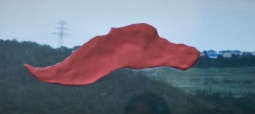
April 2026 – 15 November 2026
@tranzitiasi and @unuplusunu,
Sf. Atanasie 25, Iași
We are pleased to introduce Imagined Organisations: Practices of Artistic Research Moving Across Semiperipheries — a year-long programme of exhibitions, residencies, online seminars, and an international gathering in Iași and Chișinău, unfolding between April and November 2026 at tranzit.ro/Iași and 1+1.
The programme brings together artists, curators, and theorists to exchange practices and perspectives on how artistic organisations face the new challenges raised by the transformative impact of artistic research.
The practice and discourse of contemporary art have undergone profound changes with the emergence of artistic research, one of the most important factors that has shaped established practice in the field. Furthermore, artistic research has presented an entire set of new challenges and pressures on the institutional forms through which both state and non-state actors support artistic development. This has not been a uniform development, but one that has different characteristics across various political geographies. While in the former East, these changes overlapped with the major geopolitical shifts of the 1990s, in the former West, the rise of artistic research was strongly driven by the internal discourses and practices of universities and arts academies. It is now clear that, in both geopolitical contexts, the new demands on institutional structures arising from the need for change generated by the specific challenges of artistic research have not been fully resolved.
The programme is anchored by two key actions in its opening weeks. From 26 April to 6 May, theorist and curator Maria Hlavajova is in residence at 1+1 and tranzit.ro/ Iași under the question What kind of art institutions do we need, and why don't we have them? On 2 May, the first exhibition of the programme opens - Ghenadie Popescu's Childhood memories. Siberia 1941–1960 - gathering, for the first time, three components of his decade-long work on the testimonies of those deported from Bessarabia to Siberia.
read more /
Theo Prodromidis, Alăgam frate, tu tuti părțâli (We're running, brother, in all directions)

new commission @tranzitiasi
Address: 25 Sf. Atanasie Street, Iași
Until January 30, 2026, @tranzitiasi will offer guided tours, upon request, about the production process of the new permanent work: Alăgam frate, tu tuti părțâli (We're running, brother, in all directions), by Theo Prodromidis.
For appointmets, please send us an email at: livia.pancu@tranzit.org
read more /
Institution(ing)s:

6th November 2025 | Nomadic School | tranzit ro/ Iași (Sf. Atanasie, 25, Iași)
Tereza Stejskalová (tranzit.cz, Prague), Georg Schöllhammer (tranzit.at, Vienna), Dóra Hegyi (tranzit.hu, Budapest), Livia Pancu & Florin Bobu (tranzit ro/ Iași), Marius Alexandru Dan (independent researcher, Iași), Theo Prodromidis (independent artist, Athens), Mick Wilson (HDK-Valand/CAPIm, Gothenburg)
Cultural institutions usually operate locally, regionally and at most, at the national level, while wider, transnational configurations have been historically difficult to sustain both conceptually and infrastructurally. Attempting to answer how we connect remotely to places and people situated hundreds or thousands of kilometers away—across differences in infrastructure, resources, and political borders, this nomadic school brings together curators, historians, and artists to explore transnational cultural practices.
The public program includes a new art commission by artist Theo Prodromidis, a presentation on statehood and nation-building by historian Marius Alexandru Dan, and a discussion on transnational curating with representatives of tranzit.org network (Prague, Vienna, Budapest, Iași) moderated by Mick Wilson.
read more /
Theo Prodromidis, Alăgam frate, tu tuti părțâli (We're running, brother, in all directions)
new commission /

OPENING:
Thursday, 6th of November, 2025, 7 p.m.
@tranzitiasi
Address: Str. Sf. Atanasie nr. 25, Iași
„We're running, brother, in all directions!" is a new work by Theo Prodromidis realized with tranzit ro/Iași in the frame of the project Institution(ing)s. At this moment it consists of four casted aluminium plaques of 15x20x 1,5 cm, on which one can read an inscription in Aromanian/Vlach language, written in Latin alphabet. One of the plaques was installed in August 2025 in the village of Vrysochori, Greece and one is installed on the building where tranzit.ro/Iași is located and open to the public starting with 6th of November 2025.
In Iași, the plaque is accompanied by two photographs from Vrysochori. The first photograph, taken in August 2025, depicts teenagers gathering in the main square of the village. Behind them stands a multifunctional building that serves as both the village council headquarters and post office. On its wall, next to the post box, one can distinguish the installed plaque mentioned above. The second photograph was taken by Theo Prodromidis during his visit to Vrysochori after returning from Iași in May 2025. It shows a silver gelatin print from approximately the 1920s depicting the peak Tsouka Rossa (2,379 m) on Mount Tymfi in the Zagori region, part of the Ioannina regional unit in Epirus, Greece.
read more /
Institution(ing)s: (Cultural) Institutions in Semiperipheries | Collective study visit | Economy Lab | Iasi&Chisinau
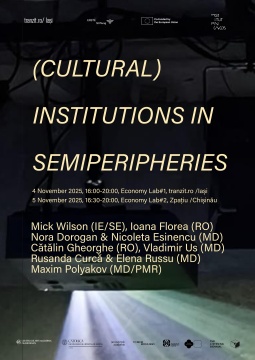
3rd of November 2025 | 19.30 – 20.30 | Iași
Pavel Brăila: Schoes for Europe, screening | tranzit-ro/ Iași (Sf. Atanasie 25, Iași)
4th of November 2025 |16.00 – 19.00 | Chișinău
Economy Lab | tranzit-ro/ Iași (Sf. Atanasie 25, Iași): Nora Dorogan & Nicoleta Esinencu (Teatru Spalatorie / Laundry Theater, Chișinău), Ioana Florea (independent researcher, Bucharest), Mick Wilson (HDK-Valand/CAPIm, Gothenburg)
5th of November 2025 | 15.30 – 18.30 | Iași
Collective study visit and public presentation | Economy Lab | Zpațiu, Zemstvei Museum (Alexei Sciusev, 103, Chișinău): Maxim Polyakov (3rd Space, Chișinau), Cătălin Gheorghe (UNAGE/Vector, Iași), Vladimir Us (Oberliht Association, Chișinău), Rusanda Alexandru Curcă & Elena Russu (Coalition of Independent Cultural Sector, Chișinău), Livia Pancu & Florin Bobu (tranzit ro/ Iasi)
read more /
Institution(ing)s: Collective Study Visit & Content Debate Assembly

3-7 November 2025
| Intermediary Meeting#2 | Collective Study Visit | Content Debate Assembly |
tranzit.ro/ Iași (Sf. Atanasie, 25, Iași)
During a five-day gathering in Iași and Chișinău, representatives of the 8 partner organizations of Institution(ing)s - Universidade Católica Portuguesa, CAM - Centro de Arte Moderna Gulbenkian, Jan van Eyck Academie, MOCA NGO, Museum of Impossible Forms, Tensta konsthall, The Listening Biennial | Errant Bodies, tranzit. ro/ Iași - together with invited participants will question what cultural institutions are and how are these (re)created within the current international relations—caught between neoliberal economics, globalizing forces, nationalist resurgence, and protectionist impulses?
With contributions by: Maria Duarte (UCP, Lisbon), Yuliia Hnat (MOCA, Kiew), Cecilia Widenheim (tensta konsthall, Stockholm), Alba Lindblad (tensta konsthall, Stockholm), Hicham Khalidi (Jan van Eyck Academie, Maastricht), Livia Pancu & Florin Bobu (tranzit. ro/ Iași), Pavel Brăila (Chișinău), Tereza Stejskalová (tranzit.cz, Prague), Georg Schöllhammer (tranzit.at, Viena), Dóra Hegyi (tranzit.hu, Budapest), Marius Alexandru Dan (Iași), Theo Prodromidis (Athens), Mick Wilson (HDK-Valand/CAPIm, Gothenburg), Ioana Florea (Bucharest), Nora Dorogan & Nicoleta Esinencu (Teatru Spălătorie, Chișinău), Cătălin Gheorghe (UNAGE/ Vector, Iași), Vladimir Us (Oberliht Association, Chișinău), Rusanda Alexandru Curcă & Elena Russu (Coalition of Independent Cultural Spaces, Chișinău), Maxim Polyakov (3rd Space, Chișinau).
Detailed info, here.
Institution(ing)s is a medium-scale collaboration project co-funded by the European Union. Views and opinions expressed are however those of the author(s) only and do not necessarily reflect those of the European Union or the European Education and Culture Executive Agency (EACEA). Neither the European Union nor EACEA can be held responsible for them. Co-funded by the European Union.
The main partner of tranzit ro is the ERSTE Foundation.
read more /
INSTITUTION(ING)S: GLOSSARY - OPEN CALL

About the Glossary
What does it mean to restitute and repair through the usage of languages, long excluded within institutional spaces, but are today sometimes over-represented? They are present in the museum, the gallery, the format of the exhibition, the performances, the conferences, among others.
Today, the creation of a glossary is an exercise to complement and continue to build from the work of writers, linguists, cultural workers in understanding how the politics of language is deeply inscribed in the ways we work, live with one another and define culture(s).
Languages, here, are described beyond words. They are not only verbal communication but also all the practices in which self and collective expression continues to visibilise, archive and evidence people, cultures and communities through the material, sonic, visual, cultural and bodily practices, inside and outside of the institution.
The glossary is a digital platform that will continue to reflect and think through the coexistence of contemporary cultures with the ones that are either lost, erased, endangered as they continue to be persecuted and ought to be revived — what are the languages we want to dismantle within our diverse vocabularies, or those we want to be loudly shared and acknowledged?
1. About the Open Call
For us, languages don't just mean words but relate to social and cultural practices, conviviality, collective, plural and fluid identities, emancipation, liberation and resistance. Often, they are things that cannot be translated into words — they are experiences to be lived.
The open call invites languages to be submitted to create a compilation of words /practices/actions/experiences that populate our lives. Therefore, they are sometimes dissonant or cannot be inside institutional walls. The submissions can be of both existent and new terms/practices/actions/experiences. We are creating an online resource that will be in dialogue with the broader Institution(ing)s project.
We are looking for materials that contain a multiplicity of meanings that a language cannot always encompass. The online glossary aims to be a platform that will host a plurality of these languages.
The submission can include but is not limited to: an image (such as a photograph; an archival document); an object; a song; a video; a choreography; a dish; a symbol; a drawing.
read more /
