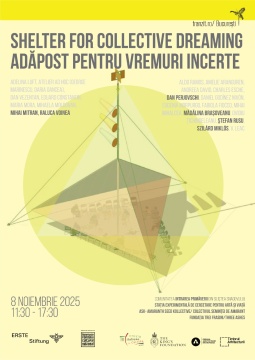
Shelter for collective dreaming / Adăpost pentru vremuri incerte
Saturday, 8 November
11:30 – 17:30
Spring Entrance Community from Siliștea Snagovului:
-The Experimental Station for Research on Art and Life
- ASK (Amaranth Seed Kollective)
-Fundația Trei frasini/Three Ashes
Programme of the day:
11:30-12:30 – Introduction to the artistic interventions realised within the project, by ASK members: Dan Vezentan, Mihai Mitran, Mihaela Moldovan, Atelier Ad Hoc (Daria Oancea & George Marinescu), Eduard Constantin
12:30-14:30 – Presentations by Mădălina Brașoveanu, Dan Perjovschi, Szilard Miklos, followed by a discussion moderated by Raluca Voinea
14:30-15:30 – Lunch prepared by Diana Voicu
15:30-17:30 – Presentation and discussion with Ștefan Rusu
Mădălina Brașoveanu (Oradea): To work in nature, with nature
The actions and interventions in the natural environment of the MAMŰ group in Târgu-Mureș were an extension of and—following the cancellation of the series of exhibitions in the lobby of Studio Theatre—a substitute for the exhibition activity of the artists. The period from the end of 1981 to the fall of 1983 represented for the MAMŰ group the time when the natural environment provided the only setting for the collective creative expressions of the artists, the site of choice for their outdoor actions being Dâmburile Umede (Vizeshalmok), situated in the vicinity of Târgu-Mureș.
The transience, the non-aggressive blending in the natural environment, and the inextricable connection with the site where they were performed, had to characterize—in the artists’ opinion—their interventions in the natural environment. Yet, they were not driven by ecological concerns. The artists treated the natural environment as an extended gallery space or studio space, the same way they treated all the other spaces where they performed various types of actions. In the outdoors, their actions benefitted from a cooperating environment, where the non-permanence / the de-materialization of the art object could unfold as a natural process, the special relationship between the forces of nature that destroy and appropriate the artistic product being one of the main aspects they were interested in.
Dan Perjovschi (Sibiu): Action „The Tree”
One of the ways to escape censorship in the 1980s was to leave the city and do whatever came to one’s mind out of the city, in nature.
Szilard Miklos (Sfântu Gheorghe): AnnART Performance Festival
The AnnART International Performance Festival (1990–1999) was organized ten times near Lake Saint Anne, formed in a volcanic crater in the Ciomad Mountains, part of the Eastern Carpathian volcanic chain. The location has symbolic and historical significance for the Székely Land, with several legends about the formation of the lake. It is also a site of pilgrimage during Saint Anne Days, a meeting point for the hiking movement that began in the 1920s, and a gathering place for young people from all regions of Transylvania over the years. While multiple generations met there, they explored a sense of community either through learning traditional folk songs, through pop music culture, or simply withdrew from the city into this hidden landscape, the location is today declared a natural reserve, which no longer allows swimming or camping around the lake. The presentation will introduce several aspects of organizing the festival in this location, far from urban infrastructure, highlighting the stratification of the audience and the artists’ responses to the challenges of the natural environment, as well as the hospitality of those who found there a sense of freedom in the 1990s.
Ștefan Rusu (Chișinău): Architectures of Survival: Fragility, Sediments, Melancholies from the Postcolonial Jungle
Insularity, as a geopolitical and imaginary situation, represents the meeting point of artistic and curatorial practice, carried out between seemingly disparate spaces: the Republic of Moldova, Central Asia (Tajikistan and Kyrgyzstan), and the Samoa Islands in the South Pacific. In geopolitical terms, insularity implies a structural relationship of dependency: the island is never completely autonomous, but linked to external flows of resources, capital and ideologies. At the same time, this peripheral position can generate spaces of resistance, experimentation, and reimagining. Far from hegemonic centers, islands become places where alternative forms of community, subsistence economies, or ways of living that contradict the norms imposed by global modernity are tested. The recent experience in Samoa (2023–2025) had as its starting point the tension between colonial history and local autonomy, exploring how memory and everyday practices interact with the island imaginary.
Thus in the Pacific, as in the broader context of the Global South, we can observe how everyday construction and housing practices – makeshift shelters, sheds, temporary structures, easily assembled living spaces for tropical climates – function not only as solutions to necessity, but also as cultural models of resilience. These practices are related to what Achille Mbembe calls the politics of improvisation, where communities in the Global South transform structural deprivations into creative resources. At the same time, the experiences in Samoa bring to the fore survival techniques as an aesthetic and epistemic strategy, revealing how marginal communities transform fragility into creative potential. These survival architectures are the expression of a continuous adaptation to environmental conditions and socio-economic precariousness, but also a form of resistance to the aesthetics of Western urbanism.
Atelier Adhoc (George Marinescu & Daria Oancea)
ATMOS 1: Specular Field Unit
ATMOS 1 is a point of contact between people, soil, and atmosphere.
The device functions as a mobile unit, temporarily positioned in an open field, creating space for multiple scenarios of learning and exchange.
The telescopic structure supports a specular textile membrane — a material used in both agriculture and space research — capable of reflecting sunlight and creating shade.
A wind sock placed at the top of the structure measures and reveals the movement and intensity of air currents, acting as a visible signal of atmospheric force.
The prototype functions as a collective resource for field-based research and learning activities, becoming a shared tool for exploring and understanding the site.
Dan Vezentan
The Rain Collector is a wooden architectural installation inspired by the shape of the whirlpool (Vâltoare)– a traditional mechanism used to wash fabrics in the rapid mountain waters. It is conceived as a space open to the public, where the whirlpool becomes a catalyst for meetings, ideas and artistic experiences. The semi-buried structure transforms into an amphitheater that can host performances, discussion sessions, sound auditions or community meetings. At the same time, the installation also has a concrete ecological dimension – its shape channels rainwater, collecting it in a central catchment basin mounted below stage level. The swirling movement of the water in the whirlpool is thus transferred into a flow of ideas, sensations and experiences.
Eduard Constantin
Shelter 4.0
This shelter is the fourth in a series of utilitarian objects/interventions, realised through practical workshops in collaboration with locals, colleagues or children. The first was built together with a group of teenagers, in a forest close to the local Forest Range, using branches from the site and left to be used by the foresters. The second was in Bechet, an area on the desertification map in southern Romania, where sheltering from the sun gave its main purpose. I realised the third in Indonesia, together with a local artist and farmer, from bamboo, a replenishing material there. The idea of a shelter for rest during the hours when heat was too pressing, as well as the mobility allowed by the use of light materials made it possible for the local who contributed to the construction of the structure, and to whom it was donated at the end of the exhibition, to still use it to this day.
All these previous experiences added motivations and structural elements to Shelter 4.0, which in Siliștea Snagovului was thought through after intense experiences of work in the field in the summer, where shade is one of the most desired elements. The construction here is multifunctional, offering a place for one person to take a nap, shade for 5-6 people, a possible mobile office space or other uses depending on the necessities of the community at the Station and around.
Mihaela Moldovan
Suspended Dreams
In the context of the project „Shelter for collective dreaming”, near Bucharest, I created an installation made of a few uncoventional hammocks made from textile fibers. Each piece is unique, intensely coloured and scattered with „thorns”, suggesting organic shapes inspired by resilient plants such as the thistle or the cactus – plants that know how to survive where shade is missing.
The anatomic and vegetal fragments, together with the „thorns” made of plastic bands, inspired from this arid landscape, tell the tale of exposed bodies and need for protection, of a temporary yet necessary refuge.
The hammocks, as in other of my previous works, are symbols of pause and recovery: suspended lace from industrial ropes, fragile but resistent spaces, places in which the body and the mind reconquer their time. Within this „shelter”, they transform into structures for meditation and survival, an oasis of friendship and community, where colours become a common languate and the air is filled with silence.
Mihai Mitran
Audiotelescope (The Whirlpool of Sounds) is an installation for collective listening, taking place in the replica of a water whirlpool. The space, imagined* as a means for collecting rain water as well as a place for socialising, becomes in this project a place of sound immersion.
The audio flux recorded during different days in the area around Siliștea Snagovului preserves the memory of the places, collected in time, in forests, on the lake, on the fields, in the village, on and around the Research Station. This is mixed during the audition with the sounds of the present, the living flux: the wind murmur, the birds song, the noises of the village, the steps and voices of the passers-by, the breath of those present. Thus, the space becomes an analogue mixer through the overlap between the sound memory and the immediate reality. Chance – an essential element in the artistic thinking of John Cage – is the invisible composer of experience. Through attention and perceptiveness, each listener decides, aware or not, which sound/thought/perception is in the foreground and what is lost to the background. Listening is transformed into an act of inner curating, a form of collective dreaming, in which time and space twist. The moment itself becomes an instrument.
*by artist Dan Vezentan
Production: Atelier Ad Hoc Community (George Marinescu and Daria Oancea), Dan Vezentan, Eduard Constantin, Mihaela Moldovan
Curation and management: Adelina Luft, Maria Mora, Raluca Voinea
Documentation: Nicoleta Moise and Andrei Becheru
Partners: The Faculty of Interior Architecture (Ion Mincu University of Architecture and Urbanism), The Italian Institute in Bucharest, OAR (The Romanian Order of Architects)
Cultural programme co-financed by the Administration of the National Cultural Fund
The program does not necessarily represent the official position of the Administration of the National Cultural Fund. AFCN shall not be held liable for the program's content or any use to which the program outcome might be put. These are the sole responsibility of the beneficiary of the funding.